Peptide Compounding Rules 2026: BPC-157, TB-500 and the HHS Policy
LegitScript Certifications
Contact Form
Table of Contents
Last updated November 2026 by Brittany Ringersen, Healthcare Compliance Advisor
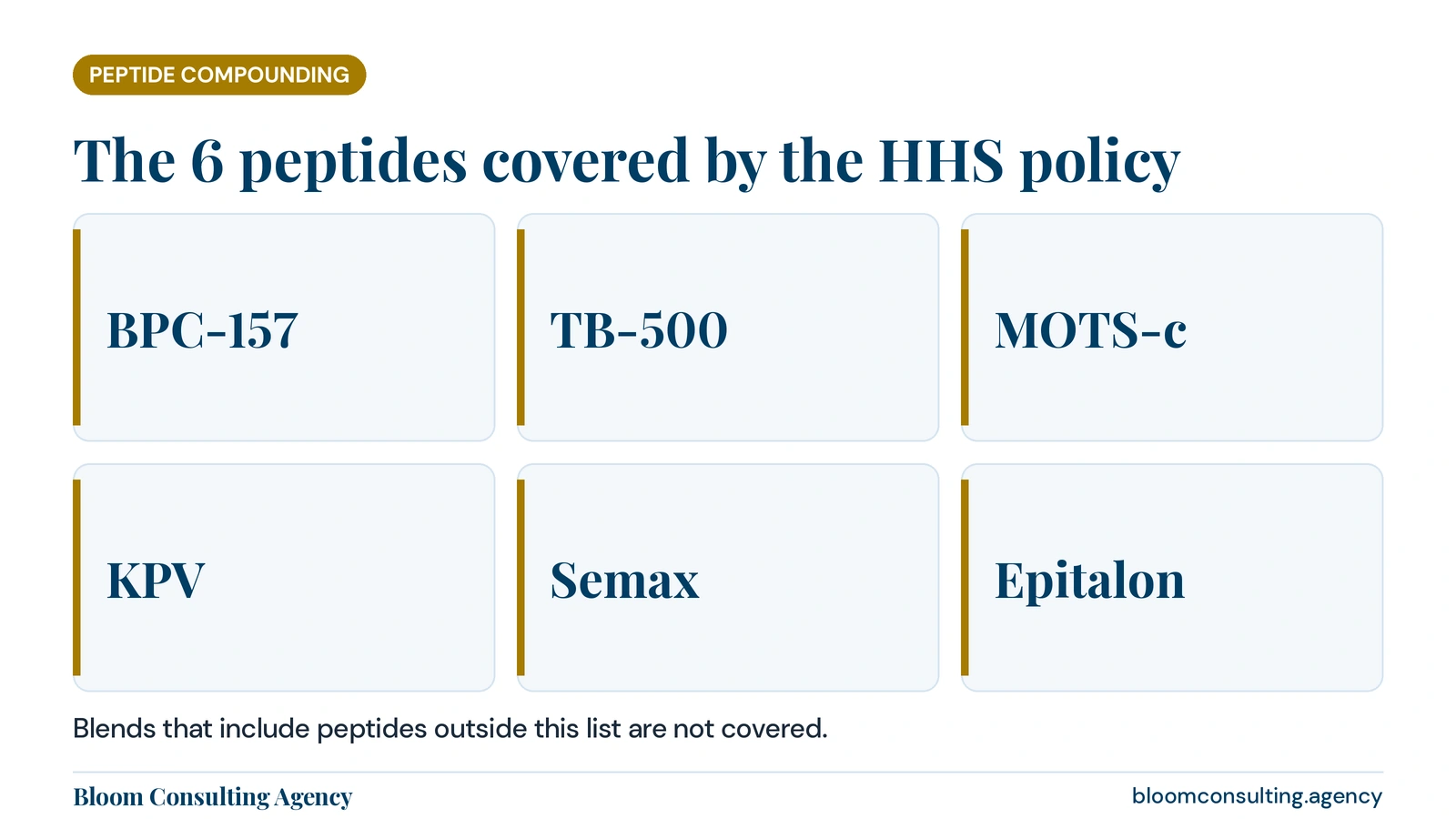
On October 30, 2026, HHS said it will not take enforcement action against 503A pharmacies and physicians that compound six peptides: BPC-157, TB-500, MOTS-c, KPV, Semax and Epitalon. From September 2023 until April 2026, those peptides sat in FDA’s Category 2, which left compounders exposed to enforcement. The change is real, but it is narrow. It comes with conditions, it can be withdrawn, and it does not make any of these peptides FDA approved.
Peptide clinics, telehealth brands and pharmacies ask us the same two questions every week: what can we sell now, and what can we say about it? This guide answers both, and covers what LegitScript and payment processors expect before you advertise.
What the HHS Peptide Policy Covers
The policy is enforcement discretion, not approval. HHS is telling compounders it won’t act against them while FDA builds the 503A bulks list through rulemaking, as long as every condition below is met. It covers six peptides, each only in the forms listed.
| Peptide | Covered forms |
|---|---|
| BPC-157 (acetate) | Subcutaneous, intramuscular, oral or topical |
| TB-500 (acetate) | Subcutaneous or intramuscular injection |
| MOTS-c (acetate) | Subcutaneous or intramuscular injection |
| KPV (acetate) | Topical or oral |
| Semax (free base) | Intranasal |
| Epitalon (acetate) | Subcutaneous or intramuscular injection, in intermittent courses |
The FDA advisory committee reviewed seven peptides in July 2026. HHS covered six and left out emideltide. Sources: Venable summary of the HHS notice (FR Doc. 2026-22192) and DLA Piper on the July advisory committee.
Conditions Every Compounder Must Meet
- 503A only. The policy names state-licensed pharmacies, federal facilities and licensed physicians compounding under section 503A. 503B outsourcing facilities are not named.
- A patient-specific prescription for every order.
- One peptide per product. Blends and combinations are not covered.
- Listed routes only. A BPC-157 nasal spray, for example, falls outside the policy.
- Verified API. The peptide must come from an FDA-registered manufacturer that follows CGMP, with a certificate of analysis that names where it was made. Resellers and repackers have to document both.
- Labeling and reporting. The label must read “This is a compounded drug product. Not for resale.” Serious adverse events and quality problems are reported to MedWatch and the state.
- Oral and injectable rules. Oral forms need documented human bioavailability. Injectables can only be dispensed with an FDA-cleared syringe.
HHS can revoke the policy for any peptide if a safety signal or quality problem shows up. Build your menu so the business still works if one product comes off it.
Peptide Blends Are Still Out
BPC-157, TB-500, MOTS-c, KPV, Semax and Epitalon can each be compounded on their own. Blends that combine them, such as “GLOW” or “KLOW” style formulas, sit outside the policy. Blends, and formulations outside the covered list such as a peptide in a route HHS didn’t name, are among the first things we flag when we review a peptide website for LegitScript.
What the Policy Does Not Cover
- Other peptides. Anything not on the list stays where it was. If a peptide has no USP monograph, isn’t part of an FDA-approved drug and isn’t on the 503A bulks list, a 503A pharmacy has no clear path to compound it.
- “Research use only” peptides. The policy covers compounded products dispensed on a prescription. It does nothing for research-grade peptides sold to consumers.
- Your marketing. Enforcement discretion says nothing about advertising claims. FDA and FTC rules still apply to every page, ad and post.
How to Sell Peptides Online Legally
- Partner with a 503A pharmacy that can show API sourcing and a certificate of analysis for each peptide. See LegitScript certification for online pharmacies.
- Put a licensed prescriber between the customer and the product. A telehealth visit, a prescription, and a license in the patient’s state.
- Sell single-peptide products in covered forms only.
- Get your website reviewed before launch. Product pages, FAQs, blog posts and intake forms all count.
- Get certified before you advertise or apply for a merchant account. Start with peptide clinic LegitScript certification and high-risk merchant accounts.
What You Can and Can’t Say
- Don’t call covered peptides “legal,” “legalized,” “FDA approved” or “FDA compliant.”
- Say “compounded” and “prescription required” plainly on product pages.
- Skip disease and treatment claims you can’t back with competent evidence. Our guide on supporting healthcare marketing claims shows what holds up.
- Hold your blog and social posts to the same standard as your product pages. LegitScript reviews all of it.
LegitScript, Google Ads and Payment Processing
If you prescribe or dispense peptides online, ad platforms treat you as a telehealth provider or an online pharmacy. Google requires LegitScript certification, or since November 2026 NABP accreditation for telemedicine, before you can apply for its healthcare certification. Visa and Mastercard recognize the same certifications for card-not-present sales. Read NABP vs LegitScript to see which fits, and payment processing for peptide clinics for the processor side.
How Bloom Helps Peptide Businesses
We review your site, product list and pharmacy partner against the HHS conditions and LegitScript’s standards, fix what would get flagged, and file your certification. With Bloom, applications are generally submitted within 10 days, and certification takes 9 to 14 days on average depending on complexity and time of year.
Talk to us about your peptide program, or keep reading:
Under the HHS policy published October 30, 2026, a 503A pharmacy or licensed physician can compound BPC-157 without FDA enforcement if every condition is met: a patient-specific prescription, BPC-157 as the only active ingredient, a covered route (subcutaneous, intramuscular, oral or topical) and verified API. It is still not FDA approved, and HHS can withdraw the policy.
Six: BPC-157, TB-500, MOTS-c, KPV, Semax and Epitalon, each only in the forms HHS listed. Emideltide was reviewed by the FDA advisory committee but left out.
Not under the policy. Each product must contain one covered peptide, in a covered form. Blends that combine BPC-157, TB-500 or others fall outside it, and so do unapproved formulations such as a route HHS didn’t list. LegitScript will flag both.
No. It names 503A compounders only: state-licensed pharmacies, federal facilities and licensed physicians.
No. None of these peptides is FDA approved, and enforcement discretion is not legalization. Avoid “legal,” “legalized,” “FDA approved” and “FDA compliant” in ads and on your site.
If you want to advertise on Google or Meta, or get a merchant account for card-not-present sales, yes in practice. Google also accepts NABP accreditation for telemedicine since November 2026.
The HHS policy doesn’t cover them. It applies to compounded products dispensed on a prescription. Selling research-grade peptides for human use stays a high-risk model that LegitScript and processors won’t approve.
With Bloom, applications are generally submitted within 10 days, and certification takes 9 to 14 days on average depending on complexity and time of year.

About the author
Brittany Ringersen, Healthcare Compliance Advisor
Brittany founded Bloom Consulting Agency, a LegitScript Enterprise Certification Partner. She helps telehealth companies, pharmacies and clinics get certified and stay compliant.